
men business casual outfit work usually means looking polished without feeling like you wore a full suit, but the gray area is exactly where most guys get stuck.
You might be in an office where one team wears hoodies, another wears blazers, and HR’s dress code reads like it was written in 2012. The goal here is simple: you want outfits that look intentional, fit your workplace, and don’t require a closet overhaul.

This guide breaks down what business casual looks like in real workplaces, how to check your office’s “true” standard, and a few reliable outfit formulas you can repeat all week. I’ll also call out the quiet mistakes that make a perfectly fine outfit read sloppy.
What “Business Casual” Means at Work (and Why It Changes)
Business casual is less a strict uniform, more a shared expectation: you look professional, you look put-together, and you’re not distracting. The tricky part is that “professional” shifts by industry, city, and even department.
According to the Society for Human Resource Management (SHRM), dress codes are often meant to support safety, inclusivity, and company image, so what passes in a creative studio may feel underdressed in a client-facing finance role.
- Client-facing roles: usually closer to “business formal lite” (button-downs, blazers, dress shoes).
- Internal roles: often more relaxed (polos, clean sneakers, knitwear).
- Hybrid offices: can be the most confusing, people dress up on collaboration days and dress down at home.
If your workplace never defines it clearly, your safest play is to dress one small step sharper than the median of your team, then adjust after you see how people respond.
A Quick Self-Check: What Level of Business Casual Are You In?
Before you buy anything, figure out which “tier” you’re actually dressing for. This saves money and avoids that awkward moment where you’re the only one in a blazer on a normal Tuesday.
- Do you meet clients, vendors, or leadership weekly? If yes, lean elevated.
- Does your office have denim on most people? If yes, business casual is likely relaxed.
- Are sneakers common and accepted? If yes, you can use premium minimalist sneakers.
- Is there a written policy with examples? If yes, follow it, then copy the best-dressed person’s “version” of it.
- Are you new or up for review/promotion? Many guys quietly dress slightly sharper during these periods, it rarely hurts.
When in doubt, take cues from the person you’d trust to represent the team in a last-minute meeting, then copy the formality level, not the exact outfit.
The Core Pieces That Make Business Casual Easy
A strong men business casual outfit work closet isn’t huge, it’s repeatable. You want a few items that mix cleanly, fit well, and look good under office lighting.
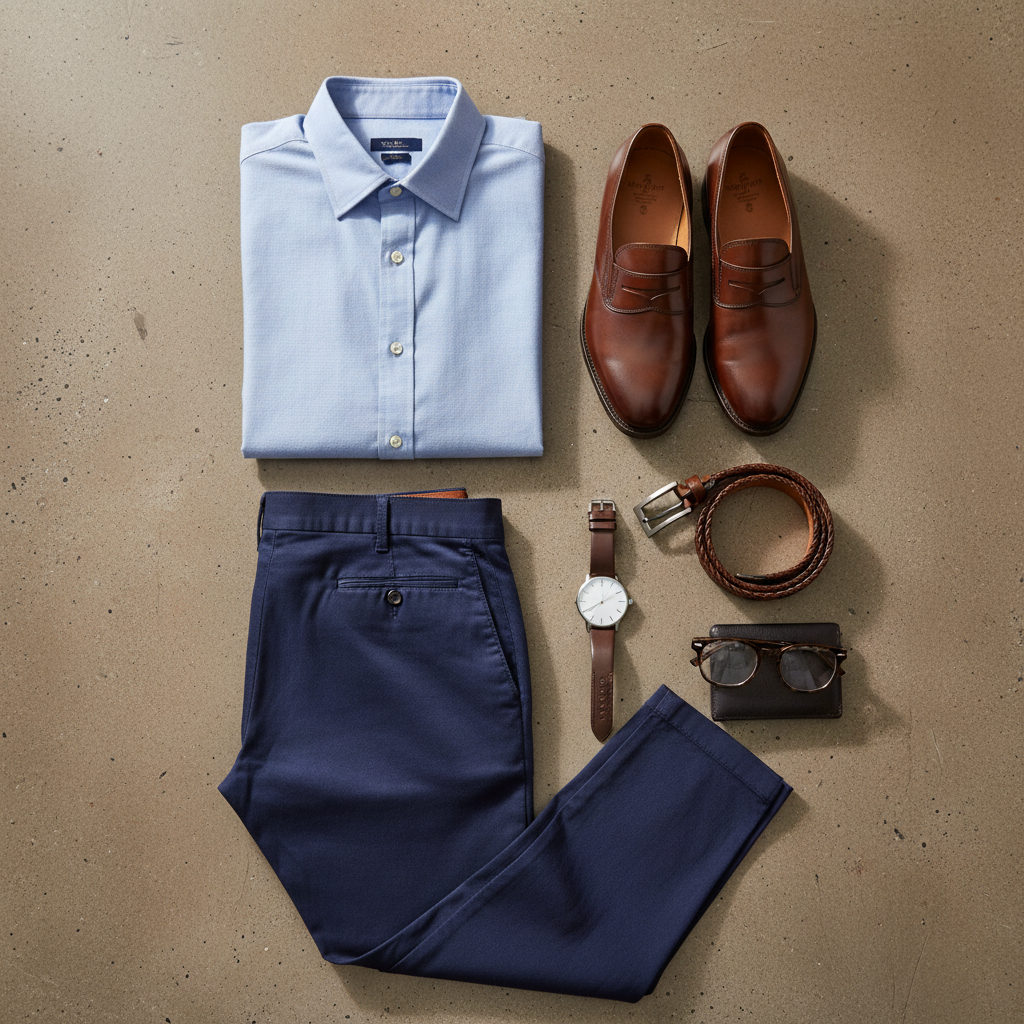
Start with these building blocks:
- Pants: chinos in navy and khaki, plus one pair of charcoal wool trousers for “sharper” days.
- Shirts: OCBD (Oxford cloth button-down) in white and light blue, plus a couple subtle patterns.
- Knits: merino crewneck or quarter-zip for layering, it instantly looks intentional.
- Jackets: an unstructured blazer or a clean chore jacket depending on your office vibe.
- Shoes: loafers or derbies for traditional offices, minimalist leather sneakers for relaxed ones.
Fit does most of the work. A $60 shirt that sits clean at the shoulders and doesn’t balloon at the waist often reads more “professional” than an expensive shirt that fits poorly.
Outfit Formulas You Can Repeat (No Overthinking)
Good business casual is about consistency. Pick a few formulas and rotate colors.
Formula 1: The safe default
- Navy chinos
- Light blue OCBD
- Brown loafers or derbies
- Optional: navy merino sweater if the office runs cold
Formula 2: Slightly elevated (meetings, presentations)
- Charcoal trousers
- White button-down or subtle stripe
- Unstructured blazer
- Dark brown shoes, matching belt
Formula 3: Relaxed business casual (tech, creative, Friday)
- Tapered chinos or dark, clean denim if accepted
- Knit polo or fine-gauge sweater
- Minimalist leather sneakers
These aren’t “rules,” they’re guardrails. If you can put any two items together and still look coherent, your wardrobe is doing its job.
A Simple Color System That Keeps You Looking Sharp
If outfits look mismatched, it’s often a color problem, not a style problem. Keep your base neutral, then add one controlled accent.
- Base colors: navy, charcoal, white, light blue, olive, beige.
- Accent colors: burgundy, forest green, rust, muted mustard.
- Easy combo rule: one dark, one light, one mid-tone.
For a men business casual outfit work setup, navy and charcoal do heavy lifting because they look professional under almost any lighting, and they pair with both brown and black accessories.
Business Casual Do’s and Don’ts (The Stuff People Notice)
Most “mistakes” aren’t dramatic, they’re subtle signals that an outfit wasn’t finished.
- Do prioritize clean shoes. Scuffed footwear pulls the whole look down fast.
- Do get pants hemmed. Stacking fabric at the ankle reads careless in many offices.
- Do keep logos quiet. A small chest logo might be fine, big branding often looks too casual.
- Don’t rely on wrinkled shirts. If ironing is unrealistic, choose fabrics that resist wrinkles.
- Don’t go ultra-skinny or ultra-baggy. Extremes date quickly and rarely look “office-ready.”
- Don’t mix too many “statement” items. Loud shoes plus loud pattern plus loud belt feels busy.
One more that’s underrated: match your belt leather to your shoe leather when you’re wearing traditional shoes. It’s a small detail, but it reads coordinated.
Practical Cheat Sheet (Table): What to Wear by Office Scenario
Use this as a quick decision tool when you’re staring at the closet five minutes before a call.
| Work scenario | Good clothing choices | Safer shoes |
|---|---|---|
| Regular office day | Chinos + OCBD, sweater optional | Loafers, derbies, clean leather sneakers (if accepted) |
| Client meeting | Wool trousers + button-down + blazer | Derbies, oxfords, loafers |
| Presentation/interview | Blazer, minimal pattern, structured look | Dress shoes, darker leather |
| Business casual in hot weather | Breathable chinos, knit polo, lightweight shirt | Loafers, sleek sneakers |
| Travel day | Stretch chinos, wrinkle-resistant shirt, light jacket | Comfortable loafers or premium sneakers |
When It’s Worth Getting Help (or Asking One Direct Question)
If you’re switching industries, starting a new job, or suddenly in front of clients, you may benefit from a second opinion. That can be a store associate who understands fit, a stylist, or even a trusted coworker with good judgment.

If you want the simplest possible script, ask: “For our office, is dark denim and clean sneakers considered business casual, or should I stick with chinos and dress shoes?” One clear answer saves weeks of guessing.
Key Takeaways You Can Use Tomorrow
- Match your outfit to your role, not just the company dress code.
- Fit and shoe condition matter more than brand names.
- Rotate a few formulas and adjust formality with a blazer, sweater, or shoes.
- Keep colors controlled, neutrals plus one accent is hard to mess up.
Conclusion: A Business Casual Wardrobe Should Feel Boring in a Good Way
A reliable men business casual outfit work approach is repeatable, comfortable, and slightly sharper than whatever “just rolled out of bed” looks like in your office. If you do one thing this week, pick two pants, three tops, and two shoes that all work together, then wear them on rotation until it feels effortless.
If you’re still unsure, take one outfit up a notch for a few days, watch the room, then dial back only if you feel overdressed, that feedback loop tends to work better than guessing from the internet.
FAQ
What counts as business casual for men at work?
Usually chinos or clean trousers, a button-down or neat polo, and shoes that look intentional. The exact line depends on your office culture and whether you meet clients.
Can I wear jeans for a men business casual outfit work setting?
In many workplaces, dark, well-fitted jeans with no fading or distressing can pass, especially in tech or creative roles. If your office is more traditional, stick to chinos or wool trousers.
Are sneakers acceptable in business casual offices?
Sometimes, yes. Minimalist leather sneakers in white, black, or dark brown tend to look more “work appropriate” than running shoes, but it still depends on the team norms.
Do I need a blazer for business casual?
Not always. A blazer is more like a formality switch, useful for meetings, presentations, and days you want to look more authoritative without wearing a full suit.
What are the best shirt types for business casual?
OCBD shirts are the easiest win because they sit between dressy and casual. Solid colors and subtle patterns look more professional than loud prints in most offices.
How many outfits do I need for a 5-day work week?
You can cover a full week with 2–3 pants, 4–5 tops, and 2 pairs of shoes if everything mixes cleanly. The trick is keeping colors compatible.
What’s the biggest business casual mistake men make?
Buying “nice” items that don’t fit, then trying to compensate with expensive shoes or a jacket. Tailoring pants and choosing the right shoulder fit often change the whole look.
If you’re building a work wardrobe from scratch or your office expectations changed and you want a more streamlined plan, it may help to map your week, pick two go-to outfit formulas, then fill only the gaps, it’s usually cheaper and less frustrating than random shopping.